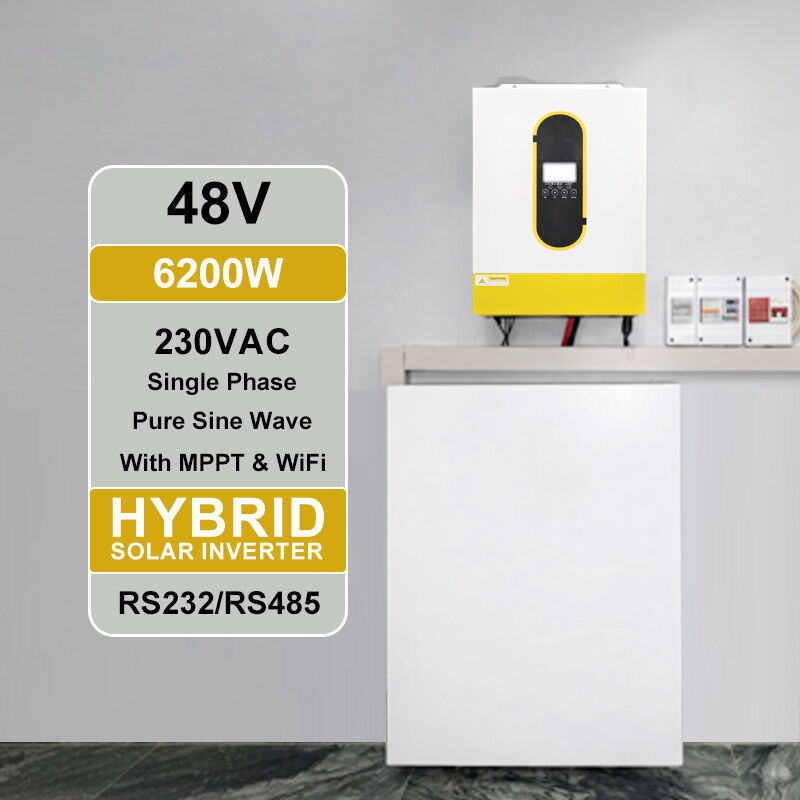
High Power Off Grid Solar Inverter 6200W 500V MPPT 120A Pure Sine Wave Dual Output
From Monthly Bill Shock to Energy Freedom: How One Malaysian Family Took Control of Their Power
Date: July 14, 2026
Location: Petaling Jaya, Selangor, Malaysia
The Protagonist: Encik Razak bin Ismail, a 44-year-old father of three and owner of a home-based graphic design studio
The Story
For Encik Razak bin Ismail and his family, life in Petaling Jaya had always been comfortable--until the electricity bills started arriving. Every month, the numbers climbed higher. Every month, the dread grew deeper.
"Opening my TNB bill became a family ritual of anxiety," Razak recalls. "We'd brace ourselves for anywhere between RM450 and RM700 per month. And it just kept climbing."
Razak's experience reflects the broader energy landscape in Malaysia, where electricity tariffs under Regulatory Period 4 (RP4) were set at 45.40 sen per kilowatt-hour, a 13.6% increase from previous periods. For households consuming over 900kWh monthly, Automatic Fuel Adjustment surcharges added unexpected costs ranging from +8.04 sen/kWh to +8.94 sen/kWh.
The Blackout That Changed Everything
In April 2026, forced outages at six major power plants tested the national grid's reserve margin. Then in June 2026, a power outage at the Yong Peng substation resulted in a 2.2GW electricity load loss--about 10% of Peninsular Malaysia's total electricity demand.
"I was in the middle of delivering a critical design project for a client in Singapore," Razak remembers. "The deadline was the next morning. At 8pm, the power went out. No lights, no internet, no way to work. I lost the client--and nearly RM2,000 in revenue."
The Right Technology Solution
Razak discovered a solar inverter system that addressed every challenge his household faced:
- Dual AC Outputs - Independent outputs for essential and non-essential devices with smart prioritization during power shortages
- Pure Sine Wave Output - Protection for sensitive electronics including design monitors, computers, and printers
- Lithium Battery Compatibility - Seamless integration with modern LiFePO4 batteries via RS485 communication
- Operation Without Battery - Direct solar power utilization during sunny days, saving battery storage for emergencies
- Wide Input Voltage Range - Handling voltage drops from 90-280VAC for appliances and 170-280VAC for computers
- High Efficiency - 94% peak efficiency ensuring maximum solar energy utilization
- Overload Protection - Handling surges up to 12,400VA for sudden power demands
- Remote Monitoring - Optional WiFi monitoring for real-time system performance tracking
The Transformation
The results were immediate and dramatic. "My first bill after installation was RM87," Razak says with a grin. "That's an 80% reduction from my previous bills. Some months, when the sun is abundant, my bill is actually a credit because I export more than I use."
During monsoon season power outages, Razak's household remained fully powered while neighbors sat in darkness. "The inverter switched over to battery mode in less than 20 milliseconds. My computers kept running, the air conditioning stayed on - we were completely unaffected."
Business Impact & Future Vision
For Razak's graphic design business, reliable clean power increased productivity by 30% and enabled 24/7 availability for international projects. His total investment of approximately RM22,000 (net RM19,000 after the RM3,000 SuRIA Home rebate) delivered payback within four years through bill savings and increased business revenue.
"Energy independence is not just about saving money," Razak reflects. "It's about resilience. It's about not being at the mercy of the grid or the utility companies. It's about taking control of your future."


 Your message must be between 20-3,000 characters!